


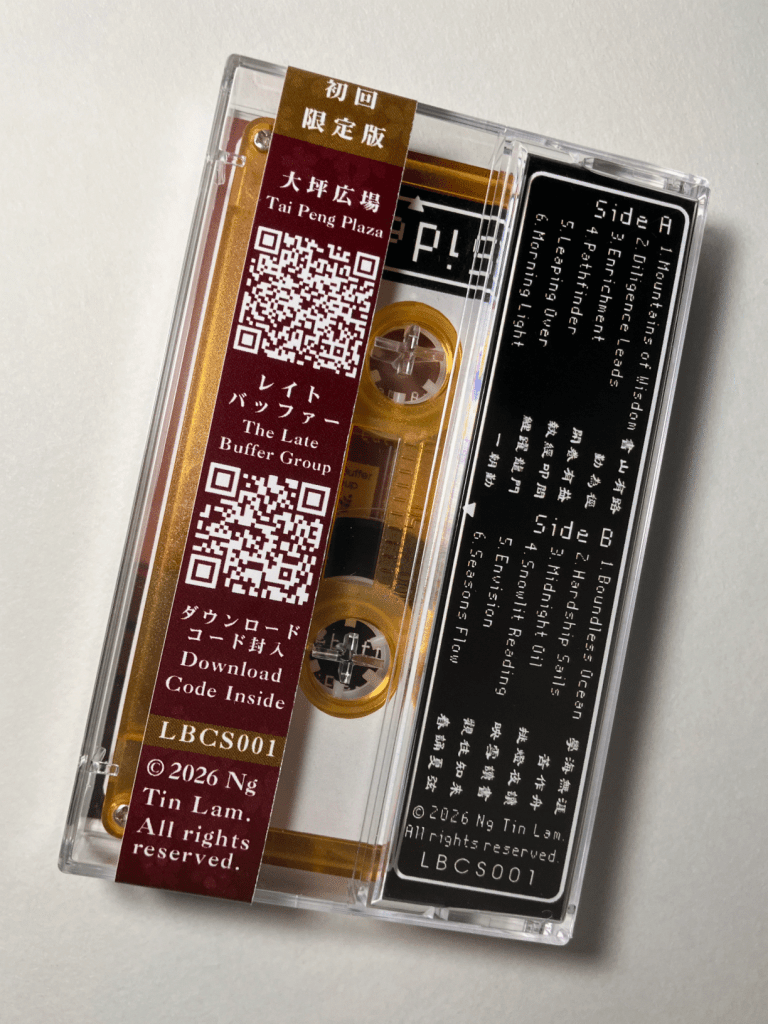
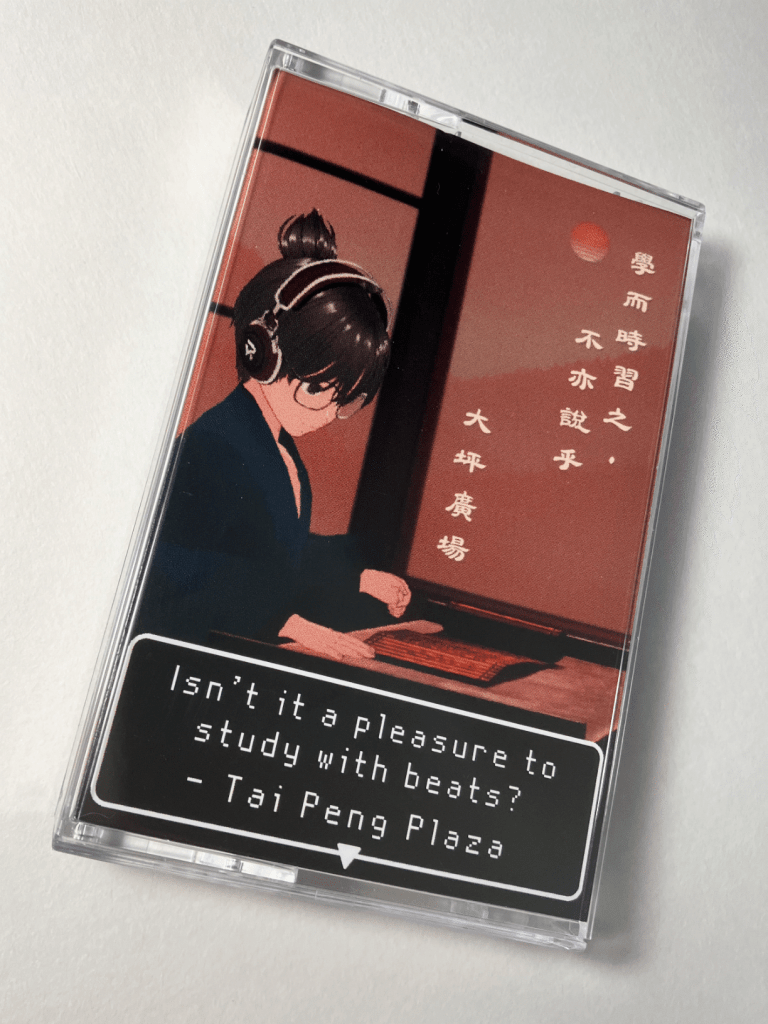
The first physical release is a cassette, “Isn’t it a pleasure to study with beats? 學而時習之,不亦說乎” by Tai Peng Plaza 大坪廣場.
You can get it on Bandcamp and at select record stores in Hong Kong.
Basement X Limited – Shop 3, heath, 36-44 Nathan Rd, Tsim Sha Tsui
Infree Records – 2nd Floor, Flat B 34-36 Nullah Road, Tung Lok Building, Prince Edward
Stone Cold Records – Rm 505, Won Hing Building, 74-78 Stanley Street, Central
WAKE Concept Store, Listening Room – Shop 3-8, Ground & 2nd Floor, Far East Mansion, 5-6 Middle Road, Tsim Sha Tsui
White Noise Records – G/F, 215 Tai Nan Street, Sham Shui Po
Zoo Records, Daily Spin Bakery & Bistro – G/F, 30 Poplar St, Tong Mi
After producing several Chinese New Year–themed singles across various styles, Tai Peng Plaza embarks on a new path with his latest album, “Isn’t It a Pleasure to Study with Beats? 學而時習之,不亦說乎.”
At the end of his previous CNY phase, centered on joy, good luck and prosperity, he realised that an essential element deeply rooted in Chinese culture had been missing: the life of learning and the discipline that shapes it. After all, during CNY, we often wish students, “May you excel in your studies.”
So why not create his own version of studying lo-fi Boy, using his newly acquired samples of traditional oriental instruments?
Each title draws inspiration from Chinese proverbs, poems, and phrases about study and learning. Evolving from lofi chill beats, the music seems to shape a new hybrid genre, one ultimately left for the audience to define.
繼多首電子風格的農曆新年主題單曲之後,大坪廣場 於其最新專輯《Isn’t It a Pleasure to Study with Beats? 學而時習之,不亦說乎》中,展開了一段全新的音樂旅程。
制作農曆新年音樂,主題往往圍繞喜悅、好運與財富。就在那個時期結束之際,他意識到,中華文化中另一個重要層面向卻未有觸及:那就對學習、努力,追求知識的重視與肯定。畢竟,在農曆新年期間,我們常會祝福學子「學業進步」。
那麼,何不創造一個屬於自己的「讀書 lo-fi Boy」,在 Downtempo 中融入傳統東方樂器等聲音素材?
專輯中每一首曲目的名稱,皆取材自與學習相關的中國成語、詩詞與語句。從 lo-fi chill beats 出發,音樂逐漸踏入一種未知境界,類型就交由聽眾自行定義。
Each track title draws inspiration from Chinese proverbs, poems, and phrases about study and learning. Evolving from lofi chill beats, the music seems to shape a new hybrid genre, one ultimately left for the audience to define.
專輯中每一首曲目的名稱,皆取材自與學習相關的中國成語、詩詞與語句。從 lo-fi chill beats 出發,音樂逐漸演化為一種未知境界,由聽眾自行定義。
Track 1 – Mountains of Wisdom 書山有路
Track 2 – Diligence Leads 勤為徑
Track 7 – Boundless Ocean 學海無涯
Track 8 – Hardship Sails 苦作舟
以上四首樂曲「書山有路勤為徑 學海無涯苦作舟」出自《古今賢文》。比喻知識為高山,勤奮就是通往知識的路;比喻知識為無際大海,刻苦就是航行大海的小船。
These four pieces are inspired by the classic Chinese proverb about study and learning, loosely translated as “Diligence leads to the Mountains of Wisdom, Hardship sails the Boundless Ocean.”
Track 3 – Enrichment 開卷有益
有說「開卷有益」源自「開卷有得」。東晉.陶淵明《飲酒·其十六》「少年來好書,偶愛閑靜,開卷有得,便欣然忘食。」陶淵明從小喜愛閱讀,讀到有所領悟時,高興得忘了進食。
直到宋代王闢之的《澠水燕談錄》「開卷有益,朕不以為勞也。」
宋太宗趙光義非常喜歡讀書,他命令當時的大文學家李昉主持編輯一套百科全書,歷經七年,終於編成了《太平御覽》。宋太宗定下了在一年內把它讀完的目標,每天讀三卷。即使政務繁忙,也要補讀。大臣們怕他勞累,常勸他多休息,但宋太宗卻說:「開卷有益,朕不以為勞也。」意思為讀書有益,不會讓我覺得累。
This piece, Enrichment, is based on the phrase “開卷有益.” The direct translation would be: “Open the book and you’ll gain something.”
It first came from the phrase “開卷有得.” A poet from the Eastern Jin Dynasty, Tao Yuan Ming, wrote: “From a young age I loved reading, quiet and calm. Opening a book and learning something new made me so happy I forgot to eat.”
It was later changed to “開卷有益,” meaning “Open the book and it is always beneficial.” This came from a story in the Song Dynasty.
Emperor Tai Zong of Song loved reading so much that he asked a famous scholar, Li Fang, to lead a team to write a large encyclopedia called Tai Peng Yu Laam. It took seven years to finish.
The emperor set a goal to read the whole book in one year, reading three volumes every day. Even when he was very busy with government work, he still found time to catch up. His ministers worried he would get too tired and told him to rest more. But the emperor said: “Reading is always helpful, and I don’t feel it’s tiring at all.”
“開卷有益” is a nice way to say that reading is good and worth doing, even if it takes time and effort.
Track 4 – Pathfinder 執經叩問
「執經叩問」出自明朝文學家宋濂的《送東陽馬生序》。全句為「又患無碩師名人與遊,嘗趨百里外,從鄉之先達執經叩問。」
宋濂自幼就愛學習, 因為家貧,只好借書謄寫、自學。即使在寒冬,墨汁結冰,手指凍僵,他仍然堅持抄寫,以求準時將書歸還。為了得到大師、名人指點,曾趕到百里以外向前輩請教。
這句成語形容求學者虛心求教、誠懇學習的態度。
Pathfinder is based on the story of Song Lian, who was a Ming Dynasty scholar. When he was a child, he was eager to learn even though his family was poor. He borrowed books, copied them by hand, and studied hard, even when the ink froze in winter. To learn from great teachers, he walked more than one hundred li (about 50 km) to ask for their guidance.
The phrase describes a passionate learner with a humble heart.
Track 5 – Leaping Over 鯉躍龍門
「鯉躍龍門」源自民間傳說。
根據漢代辛氏《三秦記》,東晉《拾遺記》和宋代《太平廣記》,「龍門」就是大禹鑿山治水時所留下的遺跡,鯉魚躍過龍門化身成龍則有不同說法。
混合了道教的版本最為廣傳:大禹開山疏浚,給洪峰鑿開一條通道,可鯉魚卻被沖出龍門,無法溯流而上返回故鄉。鯉魚遂向大禹之妻塗山女訴苦,於是塗山女奏准其父——玉帝:為了鼓勵鯉魚,躍過龍門者即化為飛龍,騰雲上天。
從此這成語就用作比喻古代書生中舉、升官等之事。視為魚化成龍,身價百倍。
Leaping Over stems from a Chinese folk legend, “Carp Jumping Over the Dragon Gate.”
According to an old Han Dynasty book called San Qin Ji, and later books such as Shi Yi Ji from the Eastern Jin Dynasty and Tai Ping Guang Ji from the Song Dynasty, the Dragon Gate was said to be a place left behind when Da Yu cut through mountains to control floods.
There are different versions of this story; the most popular one mixes in Taoist ideas:
Da Yu opened up the mountain and made a path for the floodwater, but the carp were washed out of the Dragon Gate and could not swim back home.
So the carp complained to Da Yu’s wife, Tushan Nu.
Then Tushan Nu asked her father, the Jade Emperor, for help.
The Jade Emperor agreed that to encourage the carp, any carp that jumped over the Dragon Gate would turn into a dragon and rise into the sky.
Since then, this phrase has been used to mean things like passing an important exam or getting promoted—to describe an ordinary person becoming successful, like a fish turning into a dragon.
Track 6 – Morning Light 一朝勤
「一朝勤」出自元代詩人傅若金的《港口曉行》當中的「曉逢力田者,愧爾一朝勤。」意指在清晨看見農夫辛苦耕作,慚愧自己未能一樣早起勞動。
“Morning Light” is inspired by the poem “Morning Journey at the Harbor” by the Yuan Dynasty poet Fu Ruo Jin. The poet saw farmers working hard and felt embarrassed that he wasn’t as industrious or early-rising as they were.
Track 9 – Midnight Oil 挑燈夜讀
「挑燈夜讀」意為在夜晚撥亮燈芯、熬夜讀書,比喻學習勤奮、刻苦。常見於形容學子為了功名或考試,在昏黃燈光下研讀的場景。
Midnight Oil, loosely translated from the Chinese phrase “挑燈夜讀,” refers to the image of someone studying late at night under dim light. It is often used to describe someone who is hardworking and devoted to their studies.
Track 10 – Snowlit Reading 映雪讀書
「映雪讀書」出自明朝廖用賢《尚友錄》「孫康,晉京兆人,性敏好學,家貧無油,於冬月嘗映雪讀書。」
孫康喜歡讀書,因家貧而沒有錢買燈油,沒有燈,晚上就無法讀書。於是他在冬天晚上走到室外,藉積雪反射的光繼續讀書學習。比喻刻苦求學。
“Snowlit Reading,” based on “Reading by the Light of Snow,” comes from Seung Yau Luk, written by Liu Yung-yin from the Ming Dynasty.
Sun Kang was a smart and hardworking man from the Jin Dynasty. He loved to study, but his family was very poor and couldn’t afford oil for lamps. Without light, he couldn’t read at night. So during winter, he went outside and used the light reflected off the snow to continue reading and learning. This phrase is used to describe someone who studies diligently.
Track 11 – Envision 觀往知來
「觀往知來」出自列子《沖虛經.說符篇》:「是以聖人見出以知入,觀往以知來,此其所以先知之理也。」聖人能先知先覺,是因為了解過去,便能預測未來。
Envision is loosely translated from the book Chong Heung Ging by Liet Zi. It means: “By looking at what happened in the past, you can understand what will happen in the future.”
In simple words: if you study history and notice how things change, you can guess what’s likely to happen next.
Track 12 – Seasons Flow 春誦夏弦
「春誦夏弦」出自西漢戴聖《禮記·文王世子》,描寫周朝時期「順應時節」的教育理念;春天萬物生發,學生們誦讀詩歌;夏天陽氣充沛,學生們練習琴瑟弦樂。
Seasons Flow is derived from the phrase “Spring Reciting, Summer Playing Strings,” which comes from the Book of Rites, compiled by Dai Sheng of the Western Han Dynasty.
It describes the education style during the Zhou Dynasty that followed the rhythm of nature. In spring, when everything grows, students would read and recite poetry. In summer, when the weather was full of energy, they would learn to play musical instruments.
NOT AI Music. From Hong Kong.
Style: Chill-hop / Darksynth / Deep House / Downtempo / Electronic / Instrumental /
Jazz-hop / Lo-fi House / Melodic Techno / Nu-disco / Oriental / Trip-Hop
Music is available on major streaming services and platforms, please check the links below, don’t forget to like and share!